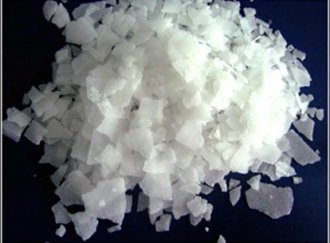
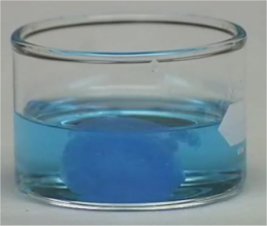
Sodium hydroxide Important chemical fact:
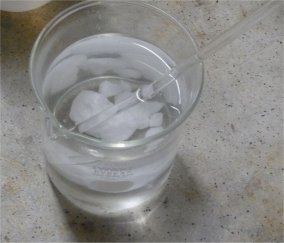
When dissolving sodium hydroxide add the NaOH slowly to cold water. |
|
||||
Most hydroxides are insoluble, but the rule that all alkali metal compounds are soluble trumps the hydroxide insoluble rule. The polar charges of water can neutralize the inter-ionic forces and dissolve the sodium hydroxide
NaOH(aq) is misleading. The solution only contains Na+(aq) and OH-(aq) since sodium hydroxide 100% ionizes. Soluble ionic compounds completely dissociate. |
|
||||
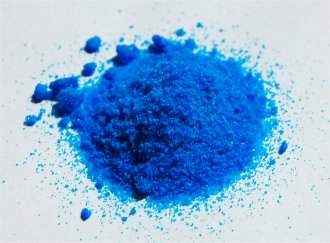
Copper (II) nitrate This picture is of the common form of copper(II) nitrate. As with many ionic compounds, it is a hydrate and the correct formula would be Cu(NO3)2•3H2O(s). So the correct name would really be copper(II) nitrate trihydrate. Anhydrous copper(II) nitrate is white. The copper ions attract water around them in a fixed ratio with a strong enough bond that the substance is a solid. The water molecules in the hydrate surrounding the copper(II) ion form a complex that produces the brilliant blue color. This compound is often referred to by its older name cupric nitrate. (Cupric is the old name for copper (II) and cuprous is the old name for copper(I). |
|
||||
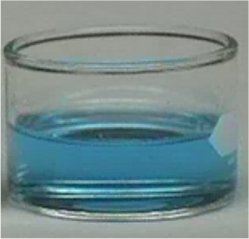
Cu(NO3)2 is soluble.
Cu(NO3)2(aq) is misleading since copper(II) nitrate 100% ionizes. |
 |
||||
When the two solutions are mixed all four ions can interact. Na+(aq) + OH-(aq) + Cu2+(aq) + NO3-(aq) There is a chance for the copper ions to attract to the hydroxide ions and the nitrate ions attract to the sodium ions. The new combinations of cations and anions are Na+(aq) and NO3-(aq) Cu2+(aq) and OH-(aq) The Na+(aq) and NO3-(aq) ions will not combine in aqueous solution since they are soluble.
Thus the precipitate Cu(OH)2 (s) forms. T Cu2+(aq) + 2OH-(aq) → Cu(OH)2 (s) |
|||||